# Multithreading in java
Hello reader!!
In this blog we'll see about **multithreading in java**. At the end of this blog you have a strong understanding about threads and you can able to create your own thread.
```sh
Content
1. What is a Thread and Multi-thread?
2. Multi-task vs Multi-thread ?
3. Thread Life cycle
4. Thread Implementation
- Inheritance
- Interface
5. Advantages of multi-threading
```
## 1. What is a Thread and Multi-thread?
- **Thread**
is a light-weight sub process or a small unit of process in a program. Each program has atleast one thread known as **main-thread** which is created by the jvm (Java Virtual Enviroment) at the run time of a program.
- **Multi-Thread**
is simply more than one thread. Java has a feature that allows concurrent execution of two or more parts of a program to make more efficient.
## 2. Multi-task vs Multi-thread
| Multi-tasking | Multi-threading |
| ------------- | ------------ |
|- Execution of a running **program**. | - Execution of an **indivual part of a program**. |
| - Each task has its **own address**. | - All threads shares a **common address**. |
| - **Heavy-weight** process | - **Light-weight** process|
| - Controlled by the **operating system**. | - Controlled by **JVM**. |
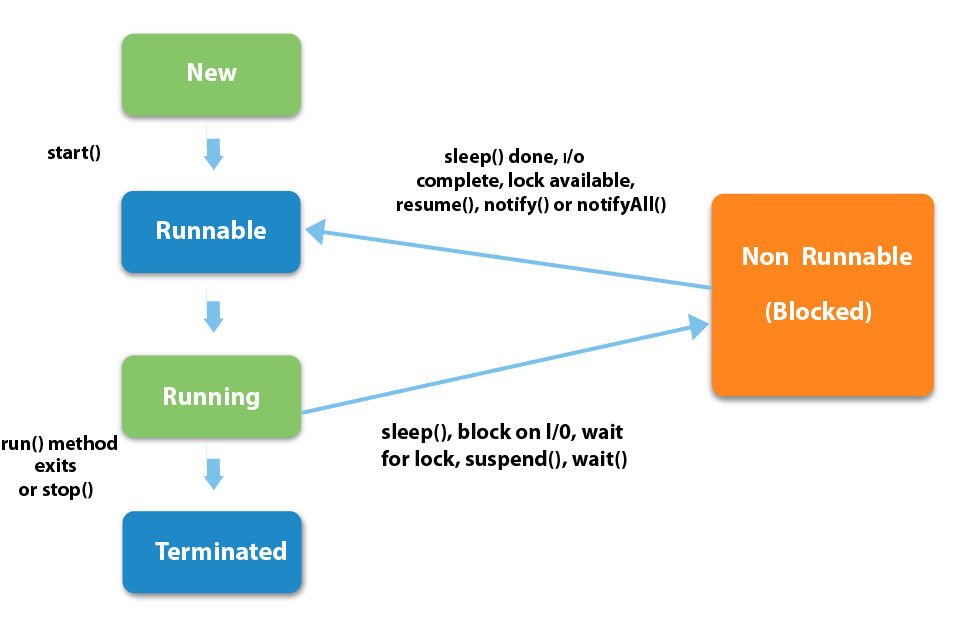
## 3. Thread Life cycle
Each and every thread has five states, which is controlled by the jvm.
Thread states as follows:
### 1. New
Whenever a instance of a thread is created,, it is said to be in a new state,
` Before the invocation of start() method.`
### 2. Runnable
After invocation of start() method, the thread is said to be in a runnable state,
` But the thread scheduler has not selected it to be the running thread.`
### 3. Running
If the thread scheduler has selected any thread for the execution then it is said to be in a running state.
### 4. Blocked/Wait
When the thread is currently inavctive but still alive, it is said to be in a blocked or waiting state.
`If any thread is waiting for i/o operation, it falls to this state.`
### 5. Terminated
when the code of thread has entirely executed or there occurred any unusual erroneous event, like segmentation fault or an unhandled exception, the thread falls to a teriminated or dead state.
## 4. Thread Implementation
A thread can be implement by creating an instance of thread from `Thread class`.
> Two Mainly used methods for thread creation follows ,
1. **start() ** is used to start a newly created thread. It performs following tasks:
2. **run() ** is used to perform action for a thread.
>
#### 4.1 Inheritance
> By `extending the thread class`, but `we can't extend any other classes`.
```java
Class Example extends Thread{
public void run(){
System.out.println("Running successfully");
}
}
Class Main{
public static void main(String args[]){
Example ex=new Example();
ex.start();
}
}
```
`Output: Running successfully`
#### 4.2 Interface
> By `implementing the runnable class` and passing it to `thread class`.
```java
class Example implements Runnable{
public void run(){
System.out.println("Thread is running by implementing runnable...");
}
public static void main(String args[]){
Example ex=new Example();
Thread t =new Thread(ex);
t.start();
}
}
```
`Output: Thread is running by implementing runnable...`
## 5. Advantages of multi-threading
- It doesn’t block the user because threads are independent and you can perform multiple operations at same time.
- Time efficient.
- Threads are independent so it doesn’t affect other threads if exception occur in a single thread.
> Thats it ! Hope It helped. Thanks for reading. Stay tuned!!.